
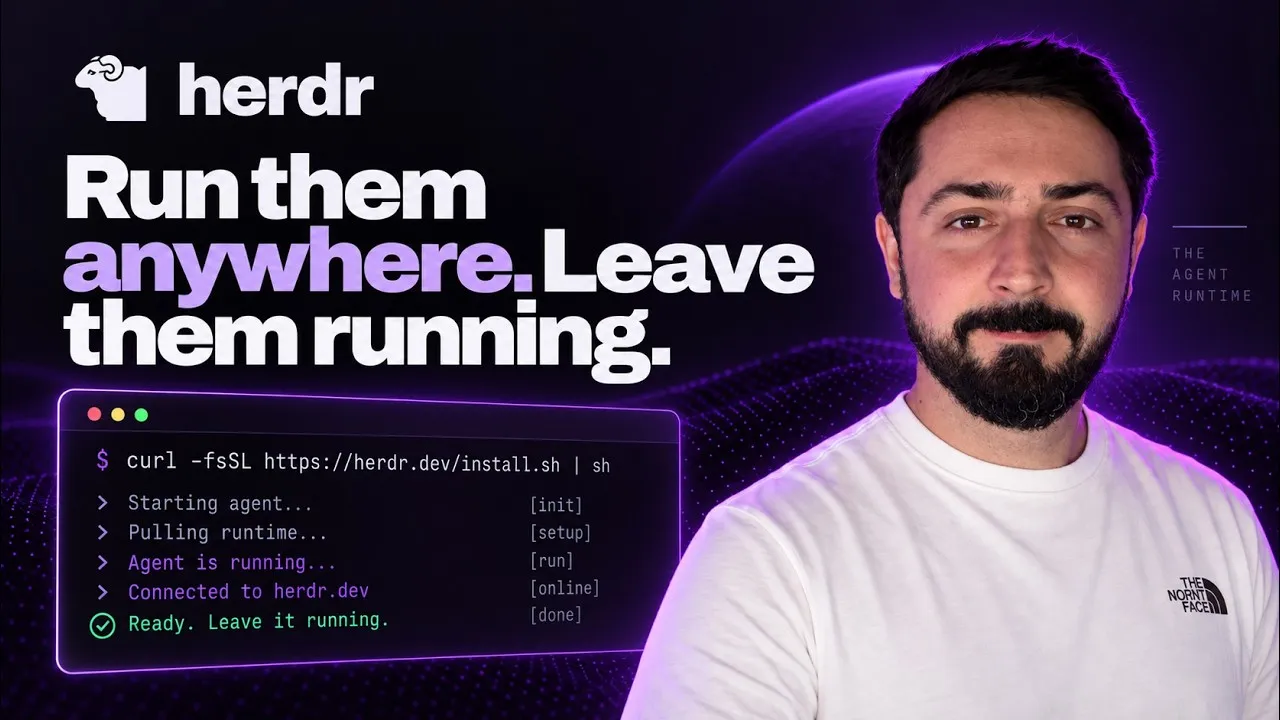
I installed Herdr to run Codex, Claude Code, Cursor, and OpenCode inside a single terminal window. I gave GPT-6 Astra in Codex the coordinator role, delegating tasks so each model built its own 3D ram in a shared Three.js scene. The coordination worked, but automated browser testing burned through two weekly token resets before the build finished.
The practical lesson from this run: orchestration between different CLI agents works surprisingly well when each agent stays inside a isolated folder, but automated browser verification loops will drain your smartest model faster than any code generation step.
Herdr only sees command-line agents
Herdr is a mouse-first terminal workspace manager designed to keep multiple coding agents visible on one screen. That way you do not forget an agent running in the background while it waits for a confirmation prompt. The site showed 36,000 GitHub stars, a purple design, and a note that they recently raised six million.
I copied the install command from herdr.dev into my terminal and ran Herdr. The interface allows switching workspaces from the sidebar, dragging panel borders to resize, and right-clicking for context menus.
Run Herdr to get started. Herdr.The initial scan picked up Claude Code, Codex, and OpenCode, but it missed Cursor. It also skipped my Antigravity IDE install. Herdr specifically manages CLI agents. If an AI tool lives only as a desktop IDE, Herdr will not detect it in the terminal.
The default terminal theme was hard to read with a bright white background. I checked settings, looked through Catppuccin and One Light Solarized, and set the system notifications and sound on toast. I ended up switching my terminal profile to basic to make the text legible.
Cursor needed a manual terminal install
Because Cursor was not picked up automatically, I installed its CLI component manually through instructions in the terminal. Once the package installed, the terminal prompted me to press any key to log in.
With Cursor logged in, Herdr had access to four tools: Codex, Claude Code, OpenCode, and Cursor.
I loaded the Herdr documentation into Codex to see if cross-agent control was supported. The docs confirmed that agents could call and coordinate each other.
The plan put GPT-6 Astra in charge of delegation
I decided to build a battle scene in Three.js where each model creates its own 3D ram model. I drew a diagram with Codex and GPT to map out the structure before starting.
The setup used GPT-6 Astra inside Codex as the primary orchestrator. Because smarter models have tighter token limits, Astra was instructed to delegate coding tasks to cheaper agents like Composer in Cursor and GLM 5.3 Flash in OpenCode.
I dropped a setup file into Codex and pointed it at an isolated project folder. Restricting all agents to a single test folder kept file edits safe from touching anything else on the machine.
Codex asked for permission to run the agent delegation command. Once approved, it began launching the secondary sessions directly inside Herdr.
Multiple active agents get noisy fast
As Codex spawned subagents, Herdr filled with open panels. The interface quickly felt busy.
Clicking any panel let me zoom into a specific agent. I heard several beeps and status alerts, but clicking through revealed that most agents were simply working through their steps rather than waiting for input. Running agents displayed a solid dot indicator.
At one point, I tried to tidy the layout and accidentally closed two active sessions. Codex detected the missing processes and reopened them automatically.
The coordination between sessions held together. One agent paused with an explicit status message reading “awaiting separate integration assignment” until the previous task concluded.
Automated browser checks burned through the token allowance
My GPT-6 Astra usage started around 70 percent. Despite instructions telling it to offload heavy work to Grok and Composer, Astra burned through the remaining allowance and forced my first weekly reset.
While the build continued, I checked Herdr documentation for remote features. Herdr supports local network connections, works remotely through Tailscale, and has a Herdr Cloud version in development.
After the first reset, Codex burned another 17 percent. It was routing fixes to Composer. Cursor was running Composer and Grok, with 21 percent weekly usage showing and a reset due the next day. In OpenCode I was using GLM 5.3 Flash.
Then Codex launched automated browser testing to verify the Three.js output. Browser testing burned most of that reset in a few minutes. In the closing summary I put the same burn at around 70 percent.
Codex hit empty again. I considered switching the orchestrator to Opus or Grok 4.6 inside Cursor, or Luna inside Codex, I activated my second weekly reset, leaving only one remaining. I asked Codex how far along it was, and it answered 95 percent complete. I told it there were no resets left and to wrap up.
The Three.js rams rendered in one shot
Before viewing the result, I checked localhost and noticed it was difficult to tell which agent had built which object. I had Codex add contributor labels above each model.
The final Three.js scene loaded with a play button:
- Astra produced a ram that hovered above the ground surface.
- Luna built a clean, decent model structure.
- Opus generated a ram without eyes.
- Composer generated a very simple low-detail ram.
- Grok and GLM each contributed their own models.
During playback, each ram steps forward with an individual animation. One sneezes, and then the entire group lines up across the screen.
The whole project was completed essentially in one shot inside Herdr without manual code edits. The orchestration worked as planned, but the token consumption during browser testing was the main obstacle.
What to copy
- Restrict multi-agent builds to an isolated folder so autonomous agents cannot touch surrounding files.
- Assign model tiers explicitly in the orchestrator prompt, routing low-complexity generation to budget models like Composer.
- Monitor browser verification loops closely. Automated visual checks consume tokens significantly faster than text editing steps.
- Turn on sound and toast notifications in the terminal manager. I could hear a beep and still could not tell whether the agent was waiting on me or still working.
Tools used
- Herdr: Terminal workspace manager for coding agents.
- Codex: Agent host running GPT-6 Astra and Luna.
- Claude Code: CLI agent interface running Opus.
- Cursor: Code editor running Composer and Grok 4.6.
- OpenCode: CLI agent running GLM 5.3 Flash.
- Three.js: JavaScript 3D library used for the scene.
- Tailscale: Secure networking tool noted in Herdr remote connection documentation.
Video chapters
- 00:00 What is Herdr?
- 00:35 First look and installation
- 01:29 Terminal setup and agent integrations
- 03:27 CLI agents explained
- 04:32 Adding Cursor
- 04:56 Planning the multi-agent build
- 05:58 Starting the agents
- 06:50 Managing the workspace
- 07:50 Token usage and resets
- 08:57 Remote access
- 09:33 Checking usage across agents
- 10:19 Running out of Codex tokens again
- 11:32 Final changes
- 11:51 The reveal: each model’s 3D ram
- 13:06 Results and final thoughts